Strength & Physique · Volume 8
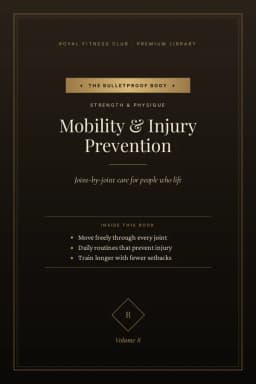
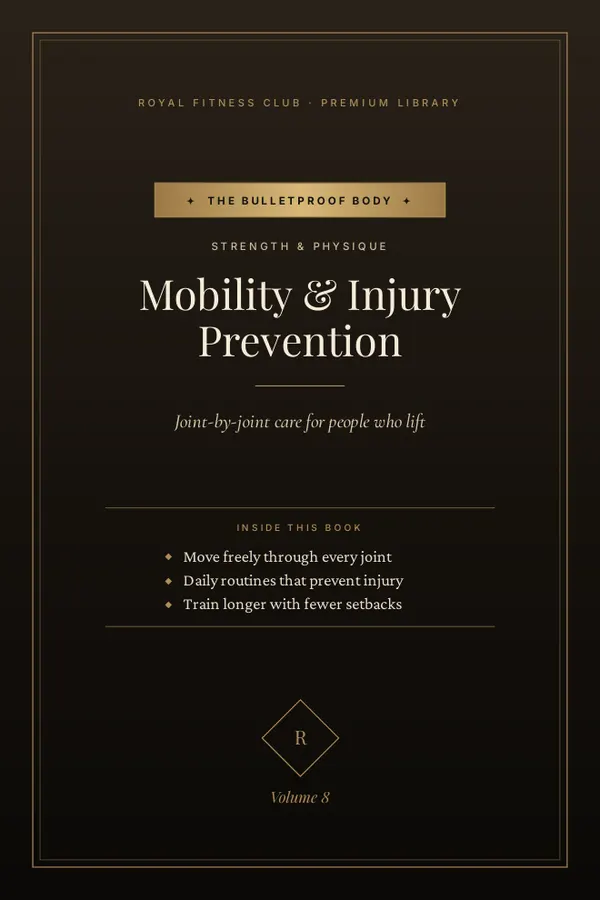
Mobility & Injury Prevention
Joint-by-joint care for people who lift
The Bulletproof Body
Signature edition
- Move freely through every joint
- Daily routines that prevent injury
- Train longer with fewer setbacks
Instant download · UPI, cards, net banking · Secured by Razorpay
Add 2+ books to your cart to save up to 30%, or get all 60 books for ₹2,999
About this book
Most training injuries don't come out of nowhere. They come from doing too much too soon, moving through ranges you don't own, ignoring early warning signs, and treating mobility as an afterthought.
This book explains what mobility really is, how injuries happen, and how to keep your ankles, knees, hips, spine, shoulders, elbows and wrists healthy for decades of training. It includes assessments you can do at home, joint-by-joint routines, warm-ups for every type of session, load-management rules, and a clear guide to what to do — and when to see a professional — when something hurts.
Train hard. Stay in the game.
Inside: 21 chapters
- 01Mobility, Flexibility and Stability
- 02How Injuries Happen
- 03Assess Yourself
- 04Ankles
- 05Knees
- 06Hips
- 07The Spine
- 08Shoulders
- 09Elbows and Wrists
- 10The Neck
- 11Warm-Ups for Every Session
- 12Load Management
- 13When Something Hurts
- 14Common Lifting Injuries Explained
- 15Mobility for the Big Lifts
- 16Returning After an Injury or Break
- 17Recovery Tools
- 18A 15-Minute Daily Mobility Routine
- 19Mobility Progress Log
- 20Questions Lifters Ask
- 21Glossary
Read the introduction
Chapter 1
Mobility, Flexibility and Stability
People use "mobility" and "flexibility" interchangeably, but they're different, and the difference matters for lifters.
• Flexibility is how far a joint can be moved passively — for example, how far someone can push your leg up while you lie relaxed.
• Mobility is how far you can actively control a joint through its range — moving there yourself, with strength.
• Stability is the ability to control position and resist unwanted movement, especially under load.
A lifter can be very flexible yet unable to control the bottom of a deep squat. Another can be strong but too stiff to reach good positions. The goal is usable range: enough mobility to reach the positions your training demands, and the strength and control to own them under load.
Why this matters
When you can't reach a position, your body finds a way around it — a "compensation". If your ankles are stiff, your heels may lift or your back may round in a squat. Compensations aren't always harmful, but under heavy, repeated load they can concentrate stress in places that don't tolerate it well.
You don't need the flexibility of a gymnast. You need enough controlled range for the exercises you do, plus a little to spare.
The book continues for 57 pages across 21 chapters.
Reader reviews
No reviews yet. Only verified buyers can review a book — every buyer gets a review form on their download page, and each review is checked before it appears here.
Save with a bundle
This book is part of these offers.
6 books · save 41%
Strong After 40 Longevity Pack
Stay strong, mobile and independent
Adults over 40: strength, mobility, heart health, everyday function and honest longevity science.
₹1,899₹3,244if bought singly6 books · save 41%
The Coach's Toolkit
Programme, coach and keep clients
Personal trainers and coaches: programming, client psychology, motivation, supplements and injury prevention.
₹2,299₹3,894if bought singly