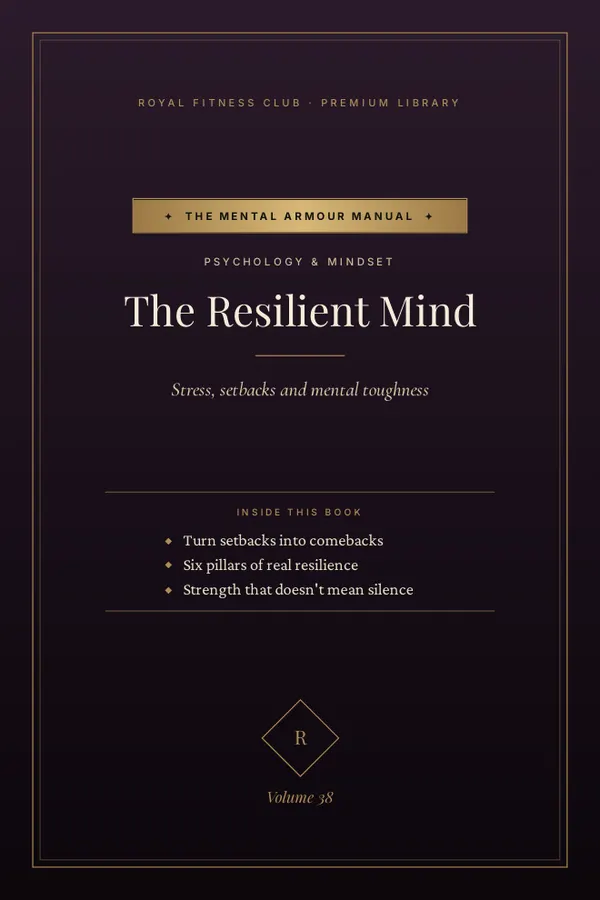
Psychology & Mindset · Volume 38
The Resilient Mind
Stress, setbacks and mental toughness
The Mental Armour Manual
Core edition
- Turn setbacks into comebacks
- Six pillars of real resilience
- Strength that doesn't mean silence
Instant download · UPI, cards, net banking · Secured by Razorpay
Add 2+ books to your cart to save up to 30%, or get all 60 books for ₹2,999
About this book
Injury. Job loss. Breakup. Illness. A plateau that lasts a year. Everyone gets knocked down. What matters is how — and how fast — you get back up.
This book explains resilience as a set of learnable skills rather than a personality trait. It covers how stress works, how thoughts shape emotions, cognitive reframing, problem-solving, emotional regulation, social support, meaning, and physical foundations like sleep and exercise. It also challenges the myths of "mental toughness" that tell people to suppress emotions and never ask for help.
For athletes, professionals, parents — anyone facing pressure.
Educational guide. It supports — never replaces — care from your doctor, and contains no doses, cycles or sources.
Inside: 20 chapters
- 01What Is Resilience?
- 02Understanding Stress
- 03The Pillars of Resilience
- 04Pillar 1: Thinking
- 05Pillar 2: Emotions
- 06Pillar 3: Action
- 07Pillar 4: Connection
- 08Pillar 5: Meaning
- 09Pillar 6: The Body
- 10Mental Toughness Reconsidered
- 11Setbacks in Sport and Training
- 12Setbacks in Life
- 13Building Resilience Daily
- 14When to Get Professional Help
- 15Resilience for Coaches and Leaders
- 16Stories of Resilience
- 17A Six-Week Resilience Programme
- 18Questions People Ask
- 19Your Resilience Workbook
- 20Glossary
Read the introduction
Chapter 1
What Is Resilience?
The American Psychological Association describes resilience as the process of adapting well in the face of adversity, trauma, tragedy, threats or significant stress.
What resilience is
• A process, not a fixed trait.
• Learnable — it can be developed at any age.
• Compatible with feeling pain. Resilient people still feel sad, scared and angry.
• Supported by relationships and resources, not just individual effort.
What resilience is not
• Never struggling.
• Hiding emotions.
• Going it alone.
• "Toughing it out" until you collapse.
Resilience isn't the absence of distress. It's the ability to move through distress and keep living according to what matters.
The surprising truth
Research by George Bonanno and others suggests resilience is common: after potentially traumatic events, many people show relatively stable functioning over time. Humans are often more resilient than we expect.
Understanding Stress
The stress response
When facing a challenge, your body releases adrenaline and cortisol: heart rate rises, energy is mobilised, attention sharpens.
The book continues for 53 pages across 20 chapters.
Reader reviews
No reviews yet. Only verified buyers can review a book — every buyer gets a review form on their download page, and each review is checked before it appears here.
Save with a bundle
This book is part of these offers.
9 books · save 52%
The Psychology & Mindset Collection
Habits, discipline and resilience
People who know what to do but struggle to keep doing it.
₹2,099₹4,391if bought singly