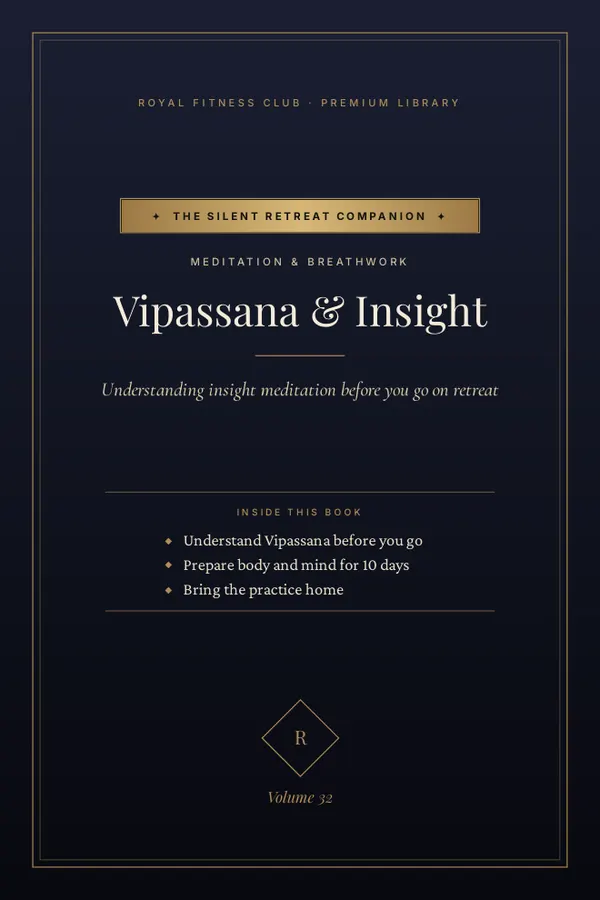
Meditation & Breathwork · Volume 32
Vipassana & Insight
Understanding insight meditation before you go on retreat
The Silent Retreat Companion
Essential edition
- Understand Vipassana before you go
- Prepare body and mind for 10 days
- Bring the practice home
Instant download · UPI, cards, net banking · Secured by Razorpay
Add 2+ books to your cart to save up to 30%, or get all 60 books for ₹2,999
About this book
Ten days. No phone, no talking, no eye contact, up at 4 a.m., meditating for ten hours a day. Every year, thousands of people sign up for a Vipassana retreat — and some leave on day 3.
This book explains what insight meditation is, where it comes from, and what actually happens on a residential retreat. It covers the core techniques (anapana, body scanning and noting), the classic insights into impermanence, unsatisfactoriness and non-self, how to prepare physically and mentally, what to do when it gets hard, and how to integrate the experience back into daily life.
An honest guide for the curious and the committed.
Educational guide. It supports — never replaces — care from your doctor, and contains no doses, cycles or sources.
Inside: 21 chapters
- 01What Is Vipassana?
- 02A Brief History
- 03The Three Characteristics
- 04The Four Foundations
- 05Technique 1: Anapana
- 06Technique 2: Body Scanning
- 07Technique 3: Noting
- 08The Ten-Day Retreat
- 09Preparing for a Retreat
- 10When It Gets Hard
- 11Psychological Safety
- 12Coming Home
- 13Insight in Daily Life
- 14Metta
- 15Choosing a Retreat
- 16What the Research Says
- 17Retreat Stories
- 18A Home Practice Schedule
- 19Questions People Ask
- 20Your Pre-Retreat Plan
- 21Glossary
Read the introduction
Chapter 1
What Is Vipassana?
Vipassana is a Pali word usually translated as "insight" or "seeing things as they really are". It refers to meditation practices aimed at direct understanding of the nature of experience.
Two wings of meditation
Traditional Buddhist teachings describe two complementary aspects:
Most insight traditions begin with some concentration (often on the breath) and then turn attention to the changing nature of all experience.
Is it religious?
Vipassana comes from the Theravada Buddhist tradition, rooted in teachings attributed to the Buddha, particularly the Satipatthana Sutta (the discourse on the foundations of mindfulness). Many modern courses present it as a non-sectarian technique that people of any faith, or none, can practise.
Vipassana doesn't ask you to believe anything. It asks you to look — closely and repeatedly — at your own experience.
A Brief History
• ~5th century BCE: the Buddha teaches in northern India. Mindfulness and insight practices are central.
• Centuries later: Vipassana is preserved mainly in Theravada countries — Myanmar, Thailand and Sri Lanka.
• 19th–20th century Myanmar: a revival of lay meditation. Teachers including Ledi Sayadaw, Mahasi Sayadaw and Sayagyi U Ba Khin develop accessible methods for laypeople.
• 1969: S.N. Goenka, a student of U Ba Khin, begins teaching 10-day courses in India. His organisation's courses are now held at centres worldwide, offered on a donation basis. Dhamma Giri in Igatpuri, Maharashtra, is one of the best-known.
• 1970s onwards: Western teachers bring insight meditation to Europe and the US (for example, Insight Meditation Society). Modern mindfulness programmes such as MBSR draw on these roots.
The book continues for 58 pages across 21 chapters.
Reader reviews
No reviews yet. Only verified buyers can review a book — every buyer gets a review form on their download page, and each review is checked before it appears here.
Save with a bundle
This book is part of these offers.
7 books · save 53%
The Meditation & Breathwork Collection
Calm, focus and deep rest
Anyone who wants a steadier mind and better sleep.
₹1,299₹2,743if bought singly